Blog - Channel Partner
Introduction: ERP as a Strategic Asset
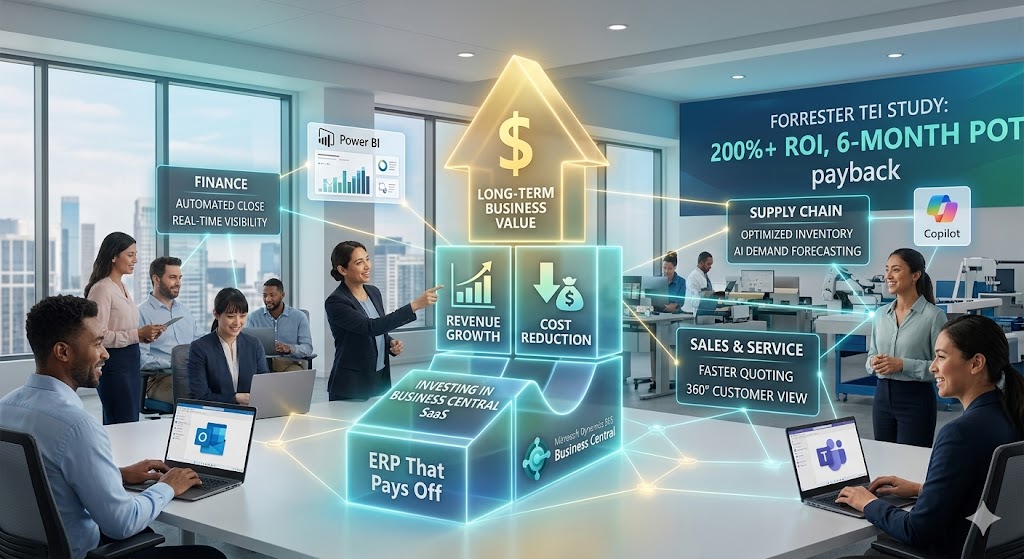
For decades, ERP systems were seen as necessary but burdensome—complex, expensive, and difficult to maintain. Business Central SaaS reframes E as a cloud-native, agile, and ROI-driven platform that empowers organizations to streamline operations, innovate faster, and scale sustainably.
The Long-Term Value Proposition
1. Financial ROI
Lower Total Cost of Ownership (TCO): SaaS eliminates heavy upfront infrastructure costs.
Predictable Subscription Pricing: Businesses pay per user, aligning costs with growth.
Reduced Maintenance Costs: Automatic updates and cloud hosting minimize IT overhead.
2. Scalability and Flexibility
Elastic Growth: Easily add users or modules as the business expands.
Industry-Specific Extensions: Tailor ERP to niche needs without disrupting the core system.
Global Reach: Cloud deployment supports multi-location operations seamlessly.
3. Continuous Innovation
Regular Updates: Microsoft delivers new features and compliance updates automatically.
Integration with Microsoft Ecosystem: Power BI, Teams, and Power Platform enhance collaboration and analytics.
Future-Proofing: SaaS ensures businesses stay aligned with evolving digital standards.
ERP That Pays Off tangible Benefits
Operational Efficiency
Automated Workflows: Reduce manual tasks and errors.
Unified Data: Real-time visibility across finance, supply chain, and sales.
Improved Decision-Making: AI-driven insights from integrated analytics.
Employee Productivity
User-Friendly Interface: Familiar Microsoft environment reduces training time.
Mobile Access: Employees can work anywhere, boosting flexibility.
Citizen Development: Low-code tools empower non-technical staff to innovate.
Customer Experience
Faster Response Times: Integrated CRM and ERP streamline service delivery.
Personalized Engagement: Data-driven insights improve customer interactions.
Global Compliance: Built-in localization ensures smooth international operations.
Comparison: On-Premises ERP vs. Business Central SaaS

Risks and Considerations
Change Management: Transitioning requires training and cultural adaptation.
Governance: Extensions and low-code apps must be managed to avoid data silos.
Vendor Dependency: Reliance on Microsoft’s ecosystem requires trust in its roadmap.
Mitigation: Establish governance frameworks, leverage certified AppSource solutions, and align IT with business strategy.
Conclusion: ERP That Pays Off
Business Central SaaS delivers long-term business value by combining financial efficiency, scalability, and continuous innovation. Unlike traditional ERP systems, it evolves with the organization, ensuring that ERP is not just a tool for managing processes but a strategic driver of growth and competitiveness.
For the Microsoft community, the message is clear: ERP pays off when it’s cloud-native, flexible, and designed for the future. Business Central SaaS embodies this vision, making ERP a catalyst for sustainable success. We encourage you to contact us for more information via our SureStep Ambassador team at channel@4sight.cloud.